Ahoy, mateys!!!
It’s a pirate unit – Argh!! For this unit, you will create a pirate-themed performance using the fighting skills we have learned, appropriate costumes and props, and your best pirate-speak voice.
Assignment #1: Form five groups of fairly equal size. Write your first and last name on the index card for your group. (participation) 2/23, 2/24
Assignment #2: With your group, create a story line for your performance. Turn in a paper with the following:
- a Character list (all of the characters and the names of the students who will play those characters. You must have pirate names (not Pirate #1, etc.).
- a summary paragraph of your plot line for the performance. It must include your conflict, climax, and resolution. Your paragraph may be in the language of your comfort, but your performance must be in English-based pirate-speak. (written work) 2/25, 2/26
Assignment #3: Create a Costume Plot (list of all the characters in the performance, what they will wear as their costume, and where that item will be sourced). (participation) 2/27, 3/2
Performance: Your performance must meet the following guidelines –
- Be in English-based pirate-speak.
- Every character must speak.
- It must include a brief sword fight (number of fighters is up to you).
- Characters must wear appropriate costumes and use appropriate props.
- The story should be told by the action and dialogue – no narrator, please.
- It should be between 1.5 and 4 minutes in length.
- Grading Rubric: Pirate-themed Storyline; Pirate-speak Used; Appropriate Pirate Costumes/Props; Audience Engagement
- Performance dates: (performance) Period 1 – 3/11; Period 6 – 3/10; Period 7 3/9.
Stage Combat – Sword Fighting
In this unit, we will study the various types of swords, learn the basics of sword fighting for stage combat, and create a choreographed sword fighting performance.
History of Swords
For this assignment, you will partner with someone then choose and research a specific type of sword. (Please remember that research requires sources.) If you do not choose a partner, you are choosing to work on your own. You will then report on your findings next class. This will count as a performance grade. You can NOT perform live without the written portion, so failure to complete the project portion will earn both partners a 0%.
Procedure:
- Choose a sword type with your partner. (You can use one from the Powerpoint list, or you can choose one on your own.)
- Research your sword type. Find a picture/drawing of the sword type and written facts. You must use at least 2 sources. (Google is NOT a source; AI generators are NOT sources. If you use Wikipedia, it can only be 1 of your sources – the other must be academic.)
- On a Canva slide, Powerpoint slide, or Word document, paste the picture of your sword and write a short description of the sword type, including your sources. You may write a paragraph or a bulleted list, but you MUST include original writing. You may use quotes as part of the text, but please be sure to cite your sources. DO NOT SIMPLY COPY AND PASTE – doing so will earn you a 0% for plagiarism.
- IF YOU ARE USING CANVA, PLEASE MAKE SURE YOU ARE ON YOUR HIALEAH-MIAMI LAKES SENIOR HIGH SCHOOL ACCOUNT BEFORE YOU CREATE YOUR SLIDE OR ELSE YOU WILL NOT BE ABLE TO SHARE IT WITH ME.
- Share (Canva) using the all caps COLLEEN MAHONEY, or email the presentation (PowerPoint or Word doc) to colleenmahoney@dadeschools.net. Include both partners’ names in the Subject Line.
- Be prepared to present this during the class after next class: 1/13, 1/20.
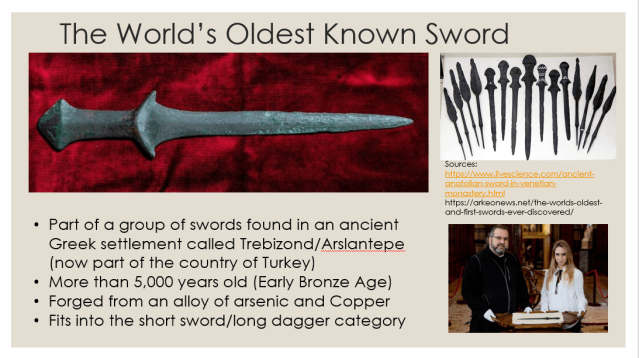
Ms. Mahoney’s Example Slide
Sword Design – For this assignment, you will design and draw the sword of your dreams. It must have a blade and a hilt, at the bare minimum. It can be modeled on a real sword or completely created in your imagination. Your sword must contain original work.
If you are in class, you will receive a worksheet for your design. If you are not, you should draw your design on a piece of paper.
This is a written work grade and is due at the end of class on 1/14, 1/15.
Sword Fight Choreography
Please pair up. (I will allow ONE group of three if the class numbers are uneven.) Get a “12 Move Sword Fight Choreography” sheet (or use a piece of paper). Decide what order you want to perform your moves in (you must use all of the moves; some you will need to use more than once). Write that order down the middle column of the sheet (Move #). The decide who will attach and who will defend for each move. Write the names in the appropriate columns. Turn the sheet/paper in before class is finished. Due by the end of class on 1/23, 1/26.
I have linked a sample sheet here should you need it for reference:
Sword Fight Choreography Performance
Now that you and your partner(s) have developed your 12 move choreography, it’s time to put it into action! Add some story to your choreo, rehearse it, and then you will perform it for the class.
Specifics:
- You must use the choreography you wrote out – no surprises!
- You should add some flair to your moves, but everything must be pre-planned and rehearsed for safety.
- You must have a storyline to your fight – a clear beginning, middle, and end. Your story must include a reason for the fight to happen and a result of the fight (win/lose/draw).
- You may add dialogue, but you do NOT need to, if the storyline of your fight is clear. Any dialogue must be in English.
- Performances will begin next class (Even Day: 1/30; Odd Day: 2/2)
8 Line Poem Performance
An important part of theatre is being able to accurately memorize your lines and cues from the script. As an actor, you do not usually have the right to just change lines; the playwright has written them in a specific way, and it is your job to faithfully reproduce those lines.
Memorization can feel intimidating at first – you may believe you don’t have the ability. You are wrong, however, and you prove it every day. You know the alphabet; how to speak at least one language; your class schedule; how to get home from school; and, likely, most of the words to at least one song. None of us were born knowing these things; we MEMORIZED them.
For this performance, you will memorize and perform an eight line poem. You may choose a longer work if you wish, but it will not earn you extra points. Eight lines is enough. Performances will not happen until after Thanksgiving break at some point, so you have plenty of time to do this.
Specifics:
- This is an individual assignment. As such, you may perform in the language of your comfort.
- Your selected poem must have eight lines. If it is longer, either use the whole piece or choose 8 contiguous (in a row) lines that make sense from beginning to end.
- For this assignment, songs are considered poetry. However, you must use verses along with the chorus (not just repeat the chorus); the lyrics must be classroom appropriate; the words must be varied – they can not just repeat over and over; and you must be able to identify the lyricist (writer of the song’s words), not just the performing artist.
- Assignments during this process submitted late will receive a reduction of one letter grade for every class period they are late.
Assignment #1 – Choosing A Work:
Spend today’s class choosing your poem. Before you leave class, please take a sheet of lined paper; put your name and class period on the top; and write the title, author, and your poem in the proper poem format on the paper. If you are performing in a language other than English, you must also write the English translation on the paper. (Use Google translate if you need to, please.) Turn in the paper before leaving class, please. Due: before the end of class (11/10, 11/12)
Assignment #2 – Pronunciation & Fluency:
- Get your poem paper back from Ms. Mahoney. If your score is a 4 (check +), move to the next step. If not, fix what is wrong and get a regrade.
- Read your poem to yourself 10 times, trying out different tones, expressions, stresses, and pauses. Take your time and decide which ones work best for your poem.
- Read your poem out loud to another person, using your decided upon tones/expressions/stresses/pauses. Ask for feedback. Incorporate worthy feedback and read it again for confirmation. Have that person sign your paper.
- Repeat with 3 other people.
- Once you have done this process 4 total times and have 4 signatures, read your poem to Ms. Mahoney, incorporating all of the best changes in presentation. Discuss. Get Ms. Mahoney’s signature and your grade.
- Due by the end of class (11/13, 11/14).
Assignment #3 – Memorization Techniques:
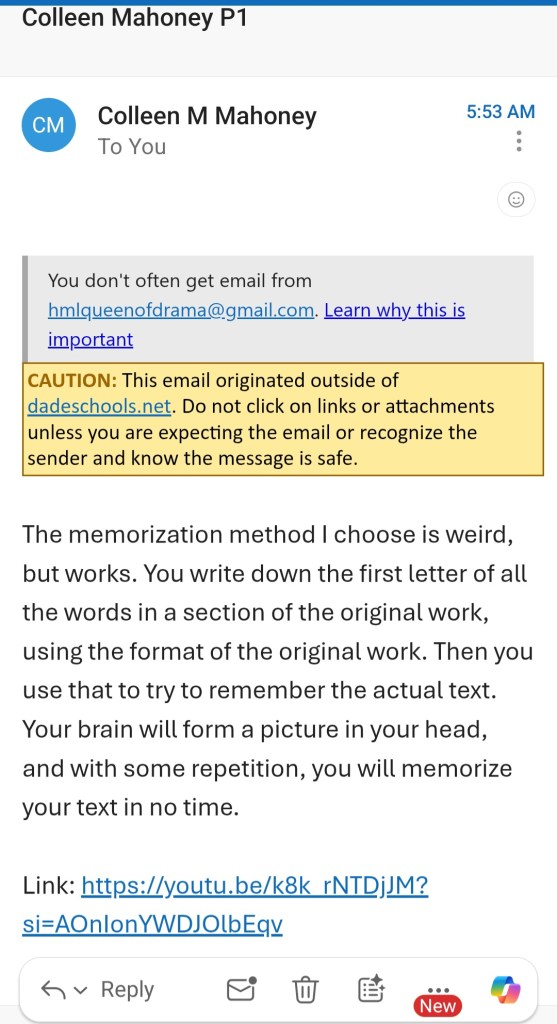
There are many ways to go about memorizing something – each one will work differently for you depending upon your material and how your brain works. For this assignment, you will research a variety of methods, choose one you think will work for you, and teach me about that method via email.
Specifics:
- Watch the video linked here: https://youtu.be/k8k_rNTDjJM?si=AOnIonYWDJOlbEqv
- Check out the sample response below.
- Research memorization techniques on YouTube or the web in general.
- Choose a technique you think will work for you.
- Write an email to colleenmahoney@dadeschools.net describing the method in a short paragraph (3-5 sentences) AND pasting the link to where you got your information from (the DIRECT link to the video or website). Use your name and poem title as the SUBJECT line.
- Your email may be in the language of your comfort.
- Google/Google AI Summaries is NOT A SOURCE. Google is a search engine which may help you find sources. You must click on the links and go to the actual sources.
- Due by the end of class 11/17, 11/18.
Assignment #4:
Using the method of your choice, work on memorizing your poem. Performances will be shortly after break, so get to work, please!
Assignment #5:
Analysis of your poem – understanding not just the surface meaning, but also any underlying meanings – is very important to a true performance of the work. To that end, today you need to get a copy of the TPFAST worksheet and complete it. It is English on one side and Spanish on the other; please complete whichever side is more comfortable for you. Respond in the language of your comfort, please – I will translate it if I need to do so.
If you get stuck, use AI or other online resources to help you!!!
The sheet is due by the end of class – 11/21, 12/1.
Assignment #6 – Off Book Test:
Today, you must prove to me that you have memorized your poem. On a volunteer basis, you will come to my desk with a written copy of your poem (on paper or on your phone) for me to review while you recite your poem to me. Once you pass your off book test, you will receive a grade and will be able to sign up for a poem performance slot. If you do not pass your off book test, you can try again after you practice your poem some more. Failure to pass your off book test by the end of class on the second day will result in you not being able to perform, so you will earn a 0% for both your off book test and your performance. Please do not do that to yourself.
Off book test dates: Odd Day – 12/4 and 12/8; Even Day – 12/5 and 12/9.
Performance dates: Odd Day – 12/10, 12/12, and 12/16; Even Day – 12/11, 12/17, and 12/19.
Blocking
Parts of the Stage
Now that we’ve spent some time getting more comfortable on stage, we need to start refining our performances. Your position on stage will make a difference in how the audience sees and accepts your character, so you need to be in the best position possible for your particular part. Therefore, you need to know the importance of your part at any given time, and you need to place yourself accordingly.
Knowing how and where to enter the stage, how to move across the stage, and where/how to stand on the stage is called blocking.
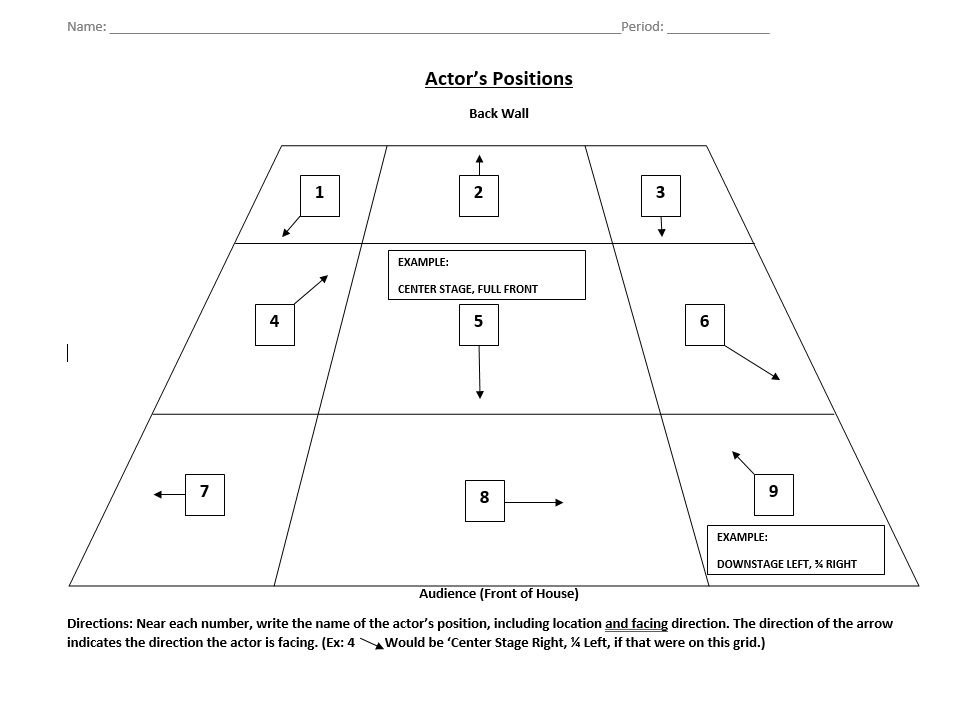
Blocking can seem like a complicated concept, but it all boils down to really only 9 stage positions, 8 body positions, and 4 possible entrances. (See the document linked below to review.)
Areas of the Stage Performance:
In this performance, you will “teach” the audience/show your knowledge of the areas of the stage. However, since I have already done the basic teaching of these areas, you must find an alternate way to teach the information. To do this, you will create a performance on your given topic which features the areas of the stage, both physically and verbally, so that your audience will better understand where each location is.
Specifics:
- Every group member must have at least 1 line.
- Groups may perform in the language of their choice, but AREAS OF THE STAGE must be spoken in English. (This is the last language choice group performance of the year.)
- All 9 areas of the stage must be mentioned in your performance.
- Groups should use costumes and props.
- Performances should be at least 1 minute but no more than 3 minutes in length.
- You will be graded on: Knowledge of Stage Areas; Inclusion of Given Topic; Group Cohesion; Audience Engagement.
Procedure:
- Form 6 groups of approximately the same size.
- Take a topic card. Topics include: pirate ship; nightclub dance floor; hospital ER/waiting room; luau; LatinX music awards show; cheering or marching band competition.
- Write your group members’ names on the card and return it to Ms. Mahoney.
- Develop your story line and performance.
- Decide upon roles.
- Rehearse.
- Perform (10/30 – Odd; 10/31 – Even).
Lesson 1 – Stage Positions and Actor’s Positions
- Watch the class presentation or review the document linked below to learn the areas of the stage (stage positions) and the possible actor’s body positions.
- Complete the associated worksheet.
- Due: The worksheet is due before you leave class. Please make sure to turn it in to the appropriate area.
On the Spot News Report
Though they are covering real life events, newscasters must be excellent actors to really build a following of faithful watchers. They must be able to react to sudden changes in situations, be able to portray a variety of believable emotions depending upon the story they are broadcasting, and be able to think on their feet.
They also must enunciate clearly, speak loudly enough to be heard no matter what is happening, and make a connection with their audiences.
For this performance, you will form a small group and create an “on the spot” news broadcast. You will have rehearsal time in class. You will be graded based upon presentation techniques (projection, enunciation, and connection), timing, audience engagement (was your audience really interested in your story and performance), and group cohesion (how well did you work together).
Guidelines:
- Form a group of 3-4 people.
- Decide the topic of your news story.
- Decide upon roles and plan out the performance.
- Provide props, if needed.
- Practice your performance.
Specifics:
- One person in the group will be the “on camera” news reporter.
- The other members of the group must have an onstage role: being interviewed, acting out the scene in the background, etc.
- Only 1 person in the group is REQUIRED to speak, but everyone must have an on stage role.
- Your “on camera” news reporter must speak English, but other characters may speak in their language of comfort.
- Like any televised news story, you must make your point in a brief time period. You have between 1 and 2 minutes to complete your performance.
Due Date:
- Performances for Odd Day classes will be October 8th.
- Performance for Even Day classes will be October 9th.
Ancient Greek Theater
Now that we’ve studied the background of Ancient Greek Theater, it’s time to act! In this section of the unit, we will look at the fashion of Ancient Greece, learn how to turn a sheet into a toga, and perform our interpretations of some traditional Greek plays.
If you missed the written assignments due to absence, please get those absences excused to remove those “z’s.”
Before we begin, please split into five fairly even groups. These will be your working groups for the rest of the unit.
Opening of schools
Please take this survey for your first grade of the year. 🙂 This survey will close at 11:59 PM on Monday, August 25th.
 HMLqueenofdrama